
Item Details
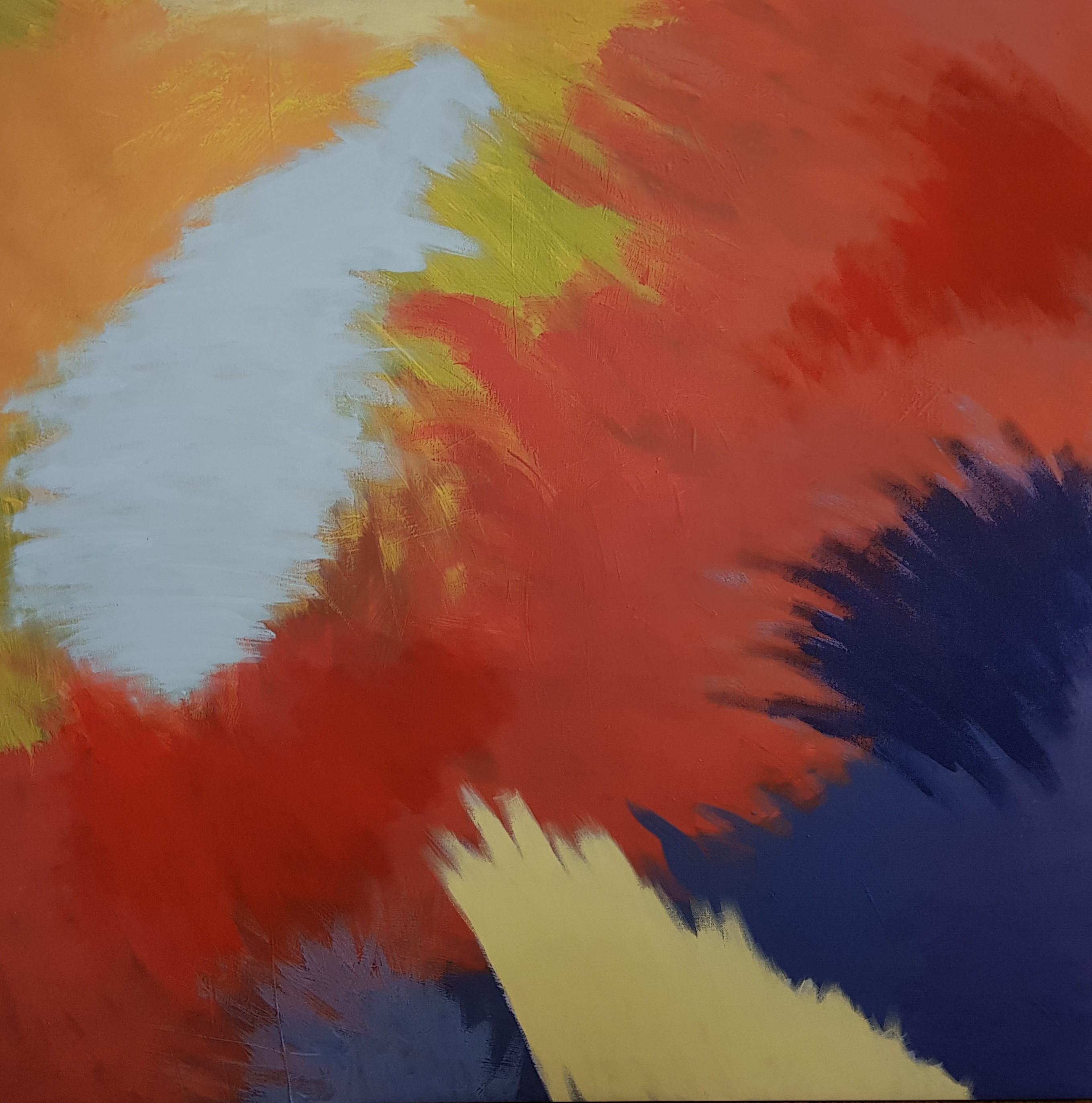

Initial thoughts of this landscape, gives the viewer the Lure into the world of “wish wash”. Where there is no discipline shown with the brush, just free moment of the sub conscious .. further investigation, reveals the colours red, yellow and blue , which have not been mixed. Ie no secondary\'s are shown. This is a good point of entry into the 4th, and opens up to conversation about the fundamentals of Art in both dimensions.. Newton, had split the colours of light and created the colour wheel. Even further back....Chakidius 300 AD used this colour palette going far as 40000 years, this basic palette has been found in caves.. so here we are 40000 years later, asking the next evolutionary step in Art..... Are there primary colours in the 4th? If so, what are they? Then , how many? Picasso’s dilemma led, of course, to Cubism. Those with a yen for early 20th century scientific theory might want to take a look at award-winning Picasso titles, offering a two-dimensional take on Salvador Dali: painting the fourth dimension Unknown Masters Salvador Dali: painting the fourth dimension The Surrealist painter Dali is largely seen as an eccentric, money-hungry artist. Many artists of the early 20th century began using the fourth dimension as the foundation with which to explore the metaphysical content of geometric symbolism. They sought to create works which allowed the viewer to simultaneously exist in both the third and fourth dimension, without the use of traditional perspective or the familiarity of subjective iconography. While the fourth dimension in all spectrums of visual art stands as an extension of the infinite, there are many different means of representation, such as time, space, or spirituality. Maurice Golubov on the “fourth dimension” The term “fourth dimension”, although technically defined using mathematical computation, generally refers to the infinite relationship between time and space, a primary artistic concern during the early 20th century. Rejecting the traditions of onepoint perspective, artists began incorporating elements of multiple perspectives in their work, essentially departing from their own three-dimensional reality and creating a world of endless possibilities. Cubism, for example, shattered the picture plane, simultaneously portraying all sides of perspective anchored on a singular plane, “painting not as they saw it, but as they thought it”. Represent the ideologies of the fourth dimension; Nassos Daphnis, Maurice Golubov, Budd Hopkins, De Hirsch Margules, Irene Rice Pereira, Rolph Scarlett and Charmion von Wiegand. By the arts and science writer, Arthur I Miller. It was published to coincide with the centenary of the death of Henri Poincaré: French physicist, mathematician, philosopher, and, according to Miller, the missing link between Picasso and Einstein. Miller writes that Poincaré 1902 book, Science and Hypothesis, pushed both the Spanish artist and the father of relativity towards great breakthroughs. Einstein came across Science and Hypothesis while working as a patent clerk in Bern, and was struck by the way Poincaré moved from the precepts of scientific theory towards a more general understanding of knowledge. Miller quotes Einstein: “Poincaré realised the truth [of the relation of everyday experience to scientific concepts] in his book.” Yet, he was also felt restricted by Poincaré reliance on lab data, pushed Poincaré’s ideas further, and hit upon the theory of relativity. Meanwhile, a friend of Picasso was also taken with the book, and took the trouble to explain some of the ideas to the artist. Red in Colour Psychology Red, with its extended wavelength, is considered a strong colour, hence its association with physical aptitude. Although it is not the most vibrant of colours, red has the capacity to seem closer to a particular observer than it actually is, therefore scoring high when it comes to attention attraction. Red has the capacity to trigger physical responses from human beings and this is the reason why it has been employed to serve utilitarian purposes like the traffic light signal for stop. This colour is also deemed masculine and is said to awaken a person’s fight or flight instinct. Some of red’s positive attributes include augmented sense of enthusiasm, warmth, and energy. The less favourable attributes are stress, hostility, and insubordination. Yellow in Colour Psychology Human emotion is directly associated with the colour yellow. Colour psychology characterizes yellow as a potent emotional stimulator, with its considerably long wavelength. Positive thinking and confidence are just some of the human attributes inspired by this colour, but, people who play around this chrome have to ensure utmost discernment since its improper usage, relative to the other shades from the colour wheel, can yield undesirable effects. Some of the negativities that misuse of the colour yellow can induce include; apprehension, terror, intense sadness, irrational thinking, and emotional vulnerability. Once properly managed, though, yellow can just as easily speak of unrivalled self-esteem, congeniality, optimism, and even artistry. Blue in Colour Psychology Human intellect, from the perspective of colour psychology, manifests all known shades of blue. This calming colour has the capacity to rouse us intellectually. Potent shades of blue inspire clarity of thought, whereas the softer variants allow utmost mental focus and serenity of the mind. Blue has been generally perceived as an endearing colour. In various cultures from all over the world, this chrome has gained a rather positive interpretation. It goes without saying, though, that blue also has its own negative associations such as coldness, isolation, and emotional unavailability. Kazimir Malevich explained in 1921, “In reality, the globe has no bottom, no top, no perspective, no weight—it does not have that most important thing upon which our knowledge of the world is based: relativity.” This statement, which expresses the radical ideas of the Suprematist movement, illuminates Malevich’s belief that art could undermine basic, yet erroneous, assumptions that inform what we accept as “natural” or “normal.”Breaking from observed reality to focus instead on the relationship between colored geometric forms on a textured white background, Malevich asked viewers to imagine a new type of realism in painting. He invoked this style through the metaphor of a spatial fourth dimension, referenced in the title of this piece, and by displaying the works without frames and refusing to assign them a precise orientation..
Place a bid